Case Study
BandMate
Understanding the users
To understand how bands coordinate, I ran group interviews with 5 bands (2 to 5 musicians each) and a survey with 27 independent musicians. I also brought five years of my own experience playing in an indie band, which meant I knew the problem firsthand and had to be careful not to design only for myself.
Across all five bands, the same pattern showed up. Plans were made in the group chat and then quietly lost. Messages got seen, skimmed, and forgotten. Nobody felt responsible for a task addressed to everyone, so responsibility defaulted to whoever cared most.
"Ist einfach im WhatsApp-Verlauf untergegangen, ohne sichtlichen Grund."
("It got lost in a WhatsApp thread, for no apparent reason.")
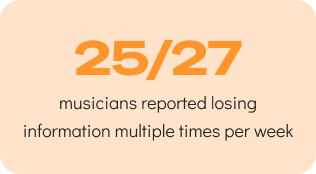
The quantitative research backed this up: 25 of 27 musicians reported losing information multiple times per week.
Lasse, the accidental manager
Lasse didn't apply for the job of band manager. He booked the first rehearsal room years ago, and somehow he's still the one chasing everyone about setlists, deadlines and gear. He doesn't want control. He wants to stop being the only one who notices when things don't get done.
Jonas, the reluctant user
Jonas, the bassist, isn't lazy. But a task mentioned in the chat on Tuesday doesn't exist for him by Thursday. He's also the reason the band's last attempt at a shared tool failed.
That attempt matters. The bands I interviewed had already tried Discord, Google Drive, TimeTree and Splitwise. Every time, they drifted back to WhatsApp, and the reasons were rarely about features: no storage space on someone's phone, one member with privacy concerns, or plain habit. A single hesitant member was enough to sink the whole tool.
The design tension
This is the problem:
Lasse needs structure, and Jonas will abandon anything that feels like being managed. BandMate only works if it serves both.
A tool that helps the organizer but feels like surveillance to everyone else ends up exactly where TimeTree did.
The interviews surfaced more than coordination pain. Finances and equipment came up in every band, and the finance problem follows the same shape: one person holds the PayPal account, nobody else knows the balance. I scoped both out of this concept to keep the core mechanism sharp, but the pattern confirmed the thesis. Bands keep concentrating shared things in one person, and the design task is to distribute them again.